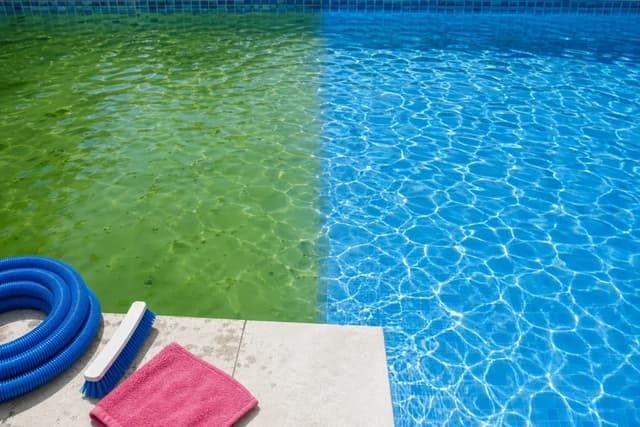
Green water is an algae bloom, and algae only takes hold after free chlorine has sat too low for days. Chlorine clears it. The amount has to match your stabilizer level, it has to stay at that level until the algae is gone, and the filter has to run the whole time.
A light bloom usually clears in 2 to 4 days. A dark green pool with leaves on the floor takes 5 days to 2 weeks.
Step 1: Judge how bad it is and test
| What you see | Typical cause | Rough timeline |
|---|---|---|
| Hazy green tint, floor visible | A few days of low chlorine or a heat wave | 2 to 4 days |
| Solid green, floor barely visible | Established bloom; walls feel slippery | 4 to 7 days |
| Dark green, steps not visible | Weeks of neglect, leaves rotting on the floor | 1 to 2 weeks or longer |
| Brown or swampy with standing debris | Abandoned pool, heavy organic load, possibly wildlife | Often a drain-and-clean candidate |
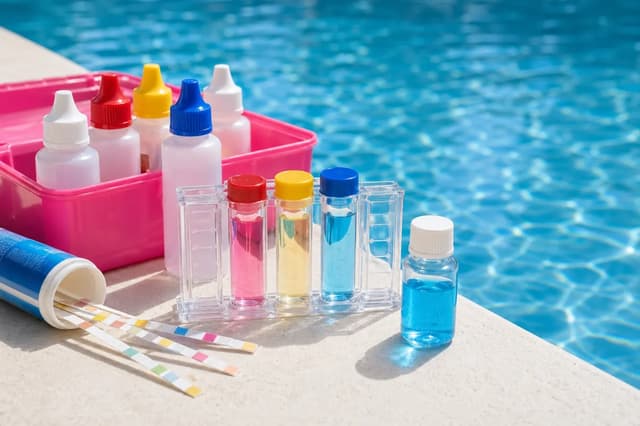
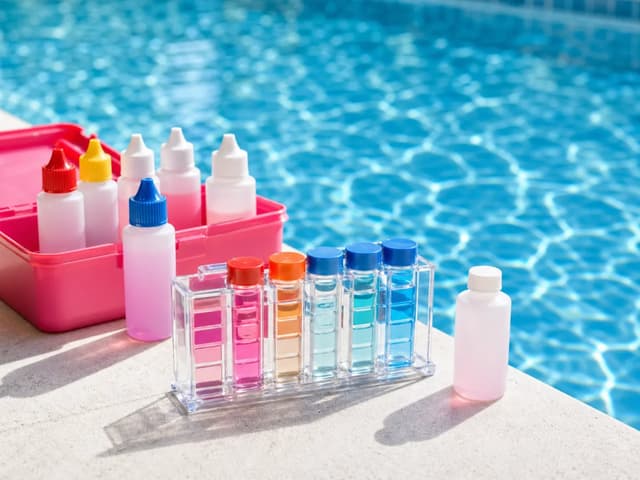
Test with a drop-based kit that reads free chlorine, pH, total alkalinity and cyanuric acid (CYA, also called stabilizer). Strips read poorly in green water. CYA is the number that sets your chlorine target; the full set of ranges is in pool chemical levels explained.
Step 2: Clear debris and prep the filter
Leaves and muck on the floor consume chlorine. Pull them out before you dose and the shock goes further.
- 1Net out leaves and floating debris with a leaf rake.
- 2Empty the skimmer and pump baskets.
- 3Clean or backwash the filter, then write down the pressure gauge reading. That is your clean baseline.
- 4Top off the water to the middle of the skimmer opening so the pump does not draw air.
- 5Brush every wall, step and the floor. Brushing strips the algae's protective film so chlorine can reach it.
If pH is above 7.8, lower it to 7.2 to 7.4 with muriatic acid or dry acid before shocking. Chlorine kills faster at lower pH. Add acid in small doses, follow the label, and retest after an hour of circulation.
Step 3: Shock to the level your stabilizer requires
One bag of shock and a wait is the most common failed fix. Stabilizer shields chlorine from sunlight and also slows it down, so the higher the CYA, the higher free chlorine must go to kill algae. Hold free chlorine at about 40% of the CYA reading until the pool clears.
| CYA reading | Free chlorine target during cleanup |
|---|---|
| 0 to 20 ppm | About 10 ppm (outdoor pools: add some stabilizer first) |
| 30 ppm | About 12 ppm |
| 40 ppm | About 16 ppm |
| 50 ppm | About 20 ppm |
| 60 ppm | About 24 ppm |
| 80 ppm | About 31 ppm |
| Over 90 ppm | A partial drain to lower CYA usually costs less than the chlorine |
Product amounts depend on volume. For a rectangle, multiply length by width by average depth in feet, then by 7.5. A 16 by 32 foot pool averaging 5 feet deep holds about 19,200 gallons. The pool volume calculator handles round, oval and kidney shapes.
| Product | Amount | Raises free chlorine by |
|---|---|---|
| Liquid chlorine, 10% | 1 gallon | About 10 ppm |
| Liquid chlorine, 12.5% | 1 gallon | About 12.5 ppm |
| Unscented bleach, 6% | 1 gallon | About 6 ppm |
| Cal-hypo shock, 65 to 73% | 1 lb | About 8 to 9 ppm, plus calcium |
| Dichlor shock, about 56% | 1 lb | About 7 ppm, plus about 6 ppm CYA |
Worked example: a 20,000-gallon pool with CYA at 40 and free chlorine at 0 needs about 16 ppm. With 10% liquid chlorine, that is 16 divided by 10, times 2, or about 3.2 gallons. Retest 30 minutes after dosing rather than trusting the math alone. The pool chemical calculator runs the same numbers for other products.
Step 4: Hold the level and filter around the clock
A green pool can burn through its chlorine in a few hours. One dose does not finish the job; the target has to be held until the algae is gone.
- Run the pump 24 hours a day until the water is clear. A variable-speed pump can run at a moderate speed.
- Test free chlorine morning and evening, and dose back to target each time.
- Brush the walls and floor once a day.
- Clean or backwash the filter when pressure rises 8 to 10 psi above your baseline. Expect that often in the first two days.
- Keep pH between 7.2 and 7.6.
The water usually turns from green to cloudy blue-gray. That haze is dead algae, and it shows the chlorine is working. A sand filter clears it faster with a cup or two of diatomaceous earth (DE) poured into the skimmer, or with a clarifier. Cloudy pool water covers clarifier and flocculant.
Step 5: Confirm the pool is actually clear
Pools that go green again a week later were taken off shock too early. Keep holding the target until all three checks pass.
- The main drain is sharply visible from the deck.
- Combined chlorine reads 0.5 ppm or lower.
- Free chlorine drops 1 ppm or less overnight. Test after sunset, add nothing, and test again before sunrise. A bigger loss means something is still consuming chlorine.
Once all three pass, let free chlorine drift down to its normal range, rebalance alkalinity and calcium, and clean the filter one more time. A cartridge that cleared a green pool often needs a degreaser soak or replacement.
When draining costs less than shocking
Shocking wins on cost in most cases. A partial or full drain makes sense when any of these is true.
- CYA is above 90 to 100 ppm, so the chlorine target climbs past what is affordable to hold.
- Inches of rotting debris cover the floor and wildlife is living in the water.
- Calcium or dissolved solids are high enough that clear water still will not balance.
When to call a pro
An early bloom is a weekend project. Bring in a pro when the cleanup outgrows your time, your test kit or your equipment.
- You have held shock level for a week and the water is still green or fails the overnight test.
- CYA is high enough to need a partial or full drain, especially where the water table is high.
- Filter pressure will not come down after cleaning, or the pump keeps losing prime.
- You would rather not handle gallons of chlorine and acid yourself.
What weekly pool service costs near you
Frequently asked questions
How long does it take to clear a green pool?
A light green pool usually clears in two to four days. A dark green pool with debris on the floor typically takes five days to two weeks. The timeline depends on holding free chlorine at shock level the whole time and on how fast the filter removes dead algae.
Why did my pool turn cloudy after I shocked it?
Cloudy blue-gray water after shocking is usually dead algae suspended in the water. Keep the pump running, keep chlorine at the target level, and clean the filter when pressure rises. The haze clears as the filter removes the debris.
Can I swim in a green pool?
No. Green water means chlorine has been too low to control bacteria, and murky water hides a swimmer in trouble. Wait until the water is clear and free chlorine has dropped back to its normal range.
Do I need algaecide to fix a green pool?
Usually not. Chlorine held at the right level kills algae on its own. Algaecide can help prevent a repeat once the pool is clear, but it does not replace chlorine, and some types foam or stain when overused.
How much shock do I need for a 15,000 gallon pool?
It depends on stabilizer. With CYA at 40 ppm you want about 16 ppm free chlorine. In 15,000 gallons that is roughly 2.4 gallons of 10 percent liquid chlorine to get there from zero, plus more to hold the level as it is used up.
Poolside guides are written for homeowners and checked against current pool chemistry and equipment guidance. Doses assume a standard drop test kit and are given per 10,000 gallons.
More Poolside guides →