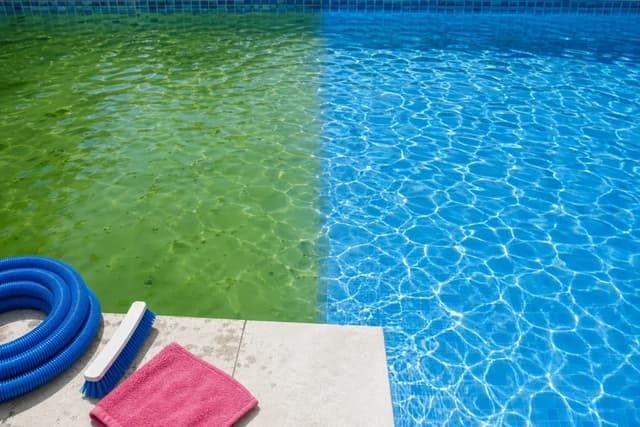
Cloudy water means fine particles are suspended in the pool that the filter is not catching and the chlorine is not destroying. The cause is almost always sanitizer, water balance or filtration, and sometimes two at once.
Clarifier is the wrong first move. Test, fix the cause, and the haze usually clears within one to two days of steady filtering.
Start with a test, not a product
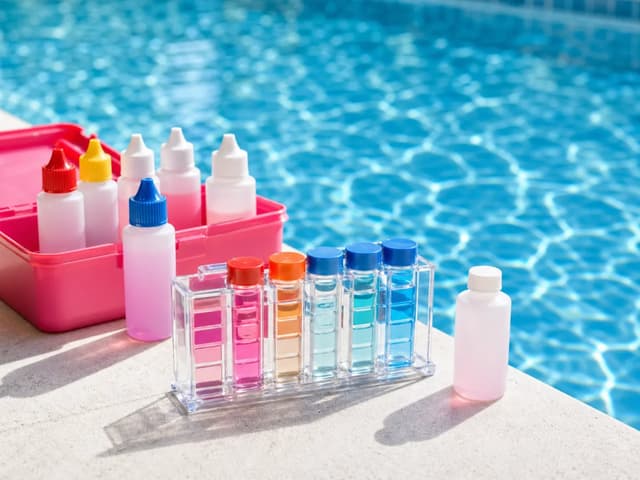
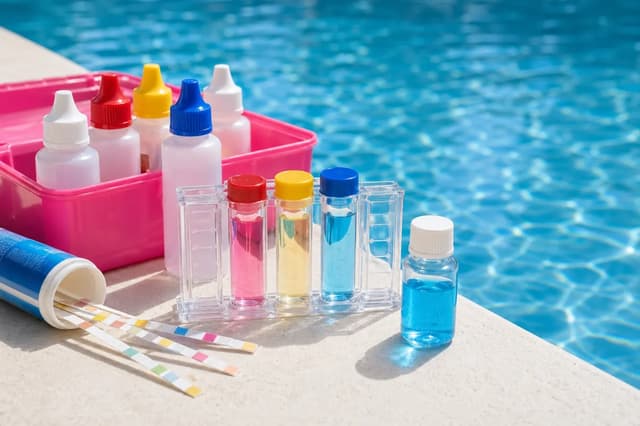
Use a drop-count kit that reads free chlorine, combined chlorine, pH, total alkalinity, calcium hardness and stabilizer. Match the results to the most likely cause below.
| What the test or pool shows | Likely cause | Section |
|---|---|---|
| Free chlorine low for your stabilizer, or combined chlorine above 0.5 ppm | Sanitizer is losing; early algae or organic buildup | Cause 1 |
| pH above 7.8 with high alkalinity or calcium | Calcium coming out of solution as fine scale | Cause 2 |
| Chemistry fine, filter pressure high or short pump run time | Filter cannot remove particles fast enough | Cause 3 |
| Chemistry fine, filter pressure unusually low | Clogged suction, worn media or a broken filter part | Cause 3 |
| Right after shocking a green pool | Dead algae waiting to be filtered out | Give it time |
| After a party, storm or pollen event | Sudden load of oils, debris or fine particles | Causes 1 and 3 |
Cause 1: Not enough free chlorine
This is the most common cause and the one to catch first. Cloudy water with low chlorine is often algae growing before it turns visibly green. Combined chlorine above 0.5 ppm, a chlorine smell or slick walls point the same way.
Raise free chlorine to shock level, about 40% of the stabilizer reading, and hold it with the pump running until the water clears and chlorine drops 1 ppm or less overnight. At CYA 40 that target is about 16 ppm. If the water already has a green tint, follow the green pool cleanup steps.
If chlorine keeps running low between cleanings, find the reason. Stabilizer under 30 ppm lets the sun burn chlorine off in hours. Heat, heavy use and debris all raise demand. A more frequent cleaning schedule or a steadier chlorine source, such as a sized tablet feeder or salt cell, is often the real fix.
Cause 2: High pH, alkalinity or calcium
Above pH 7.8, and especially with high alkalinity and calcium, calcium carbonate comes out of solution as microscopic particles. The water turns milky or dull, and white scale may show at the tile line. Chlorine also slows at high pH, so this cause often stacks on top of the first one.
- 1Bring pH down to about 7.4 with muriatic acid or dry acid, added in small doses with the pump running.
- 2If alkalinity is above 120 ppm, lower it over several days with repeated acid doses followed by aeration.
- 3If calcium is far above 400 ppm, drain part of the water and refill with softer water. No chemical removes calcium.
Target ranges and adjustment doses for each number are in pool chemical levels explained, and the pool chemical calculator sizes the acid dose for your volume.
Cause 3: The filter is not keeping up
Balanced, well-chlorinated water still looks hazy when the filter falls behind. Work through these checks.
- Run time: the pump should turn over the full pool volume at least once a day. Run it around the clock until the water clears.
- Pressure: clean or backwash at 8 to 10 psi above the clean reading. A filter that is never cleaned slowly chokes off flow.
- Sand: grains wear smooth and channel over the years. Most manufacturers suggest replacing sand every 5 to 7 years.
- Cartridge: look for torn pleats, crushed end caps or pleats that stay dirty after hosing. Soak in cartridge cleaner or replace.
- DE: powder blowing back into the pool means a torn grid or cracked manifold.
- Valves and returns: confirm flow is not being diverted to a spa or water feature.
Sand catches coarser particles than cartridge or DE media, so sand-filter pools hold a haze longer. A cup or two of DE poured through the skimmer coats the sand and tightens filtration. Check the filter manual before trying it.
Clarifier, flocculant or time
Once the cause is fixed, these options speed up the last step. None of them fixes chemistry or a failing filter.
| Option | How it works | Best for | Downsides |
|---|---|---|---|
| Time and filtering | The filter catches particles on each pass | Mild haze after the cause is fixed | Can take a few days on a sand filter |
| Clarifier | Clumps fine particles into ones the filter can catch | Moderate haze, sand filters, after shocking | Works over a day or two; overdosing makes haze worse |
| Flocculant (floc) | Binds particles into heavy clumps that sink overnight | Very cloudy water you need clear fast | Pump off; vacuum to waste and lose water; most cartridge setups cannot |
| DE added to a sand filter | Adds a finer layer on top of the sand | Sand filters that never get the water sparkling | Must be backwashed out later |
Less common causes
- New plaster sheds fine dust for the first few weeks. Brush daily and follow the plaster contractor's start-up schedule.
- Pollen and fine dust pass through screen enclosures. Add filter run time and dose clarifier during peak season.
- Metals from fill water or corroding equipment turn water cloudy green or brown right after shocking. Test for copper and iron before adding more chlorine.
- Phosphates do not cloud water directly but feed algae when chlorine drops. Holding chlorine in range matters more than chasing phosphate readings.
When to call a pro
Most cloudy pools clear within a few days once the cause is fixed. Bring in a pro when the haze outlasts the fix or the cause is mechanical.
- The water stays cloudy more than a week after chemistry is in range and the pump runs continuously.
- Sand or DE powder is coming back into the pool.
- Filter pressure stays high right after cleaning, or stays unusually low.
- The pool turns cloudy and then green every few weeks, which points to a chlorine supply or schedule problem.
What weekly pool service costs near you
Frequently asked questions
How long does it take for a cloudy pool to clear?
Usually one to three days once the cause is fixed and the pump runs continuously. Sand filters take longer than cartridge or DE filters. Flocculant can clear water overnight but requires vacuuming to waste.
Why is my pool cloudy after shocking?
Usually dead algae and organic debris that the shock broke down, which the filter still has to remove. Cal-hypo shock can also cloud water briefly when pH or calcium is high. Keep the pump running and clean the filter as pressure rises.
Is it safe to swim in a cloudy pool?
No. If you cannot clearly see the main drain at the deepest point, a swimmer in trouble could be hidden, and cloudy water often means chlorine is too low. Wait until the water is clear.
Should I use clarifier or flocculant?
Use clarifier for mild to moderate haze and on cartridge filters. Use flocculant for very cloudy water when you can vacuum to waste through a sand or DE filter. Neither replaces fixing the underlying cause.
Can high pH make a pool cloudy?
Yes. High pH, especially with high alkalinity and calcium, makes calcium carbonate come out of solution as fine particles. Lower pH to about 7.4 and bring alkalinity into range.
Poolside guides are written for homeowners and checked against current pool chemistry and equipment guidance. Doses assume a standard drop test kit and are given per 10,000 gallons.
More Poolside guides →