Pool chemistry comes down to seven numbers. Free chlorine and pH change daily and do most of the work. Alkalinity, calcium, stabilizer and salt change slowly and set the conditions the first two work in.
The ranges below are what most pool pros run on a residential outdoor pool. Salt generators and some finishes carry their own limits, so check the equipment manual when it disagrees with this table.
Target ranges at a glance
| Reading | Target range | Test how often | Outside the range |
|---|---|---|---|
| Free chlorine (FC) | At least 7.5% of your CYA reading: about 3 ppm at CYA 40, 5 to 6 ppm at CYA 70 | 2 to 3 times a week in summer | Too low: algae and bacteria. Above about 10 ppm: faded swimwear and irritation |
| Combined chlorine (CC) | 0.5 ppm or lower, ideally 0 | Weekly | Chlorine smell and red eyes; the pool needs more free chlorine |
| pH | 7.2 to 7.8; 7.4 to 7.6 is the sweet spot | 2 to 3 times a week | Low: etched plaster, corroded metal, stinging eyes. High: scale, cloudy water, weaker chlorine |
| Total alkalinity (TA) | 60 to 120 ppm; 80 to 100 is common; salt pools often run 60 to 80 | Weekly to monthly | Low: pH swings. High: pH keeps rising and scale forms |
| Calcium hardness (CH) | 200 to 400 ppm for plaster; 150 to 250 ppm for vinyl or fiberglass | Monthly | Low: plaster etching. High: scale and cloudy water |
| Cyanuric acid (CYA, stabilizer) | 30 to 50 ppm with tablets or liquid chlorine; 60 to 80 ppm with a salt system | Monthly | Low: sun burns off chlorine in hours. High: chlorine works slowly |
| Salt (salt pools only) | Usually 2,700 to 3,400 ppm; follow the generator manual | Monthly and after heavy rain | Low: the cell stops producing. High: corrosion risk and error codes |
Free and combined chlorine
Free chlorine is the sanitizer still available to kill germs and algae. Combined chlorine, or chloramines, is chlorine that has already reacted with sweat, urine and other nitrogen compounds. Total chlorine is the two added together.
The sharp "chlorine smell" at a pool comes from combined chlorine, not from too much chlorine. When CC reads above 0.5 ppm, raise free chlorine to shock level and hold it until CC drops.
The right free chlorine depends on stabilizer. CYA shields chlorine from sunlight and also slows it down. A pool at CYA 30 is protected at 2 to 3 ppm FC; a pool at CYA 80 needs about 6 ppm to do the same job. Keep FC at or above 7.5% of the CYA reading every day, and use about 40% of CYA as the shock target.
Raise FC with liquid chlorine, cal-hypo, tablets or, on a salt pool, a higher generator output. One gallon of 10% liquid chlorine raises FC about 10 ppm in 10,000 gallons. No chemical lowers it; stop dosing and let sun and swimmers use it up. The pool chemical calculator converts a target into an amount for your volume and product.
pH and total alkalinity
pH controls swimmer comfort, chlorine strength and whether the water attacks or coats your surfaces. Chlorine is noticeably weaker at pH 8.0 than at 7.4.
Total alkalinity is the buffer that resists pH change. Below 60 ppm, pH bounces with every rain and chemical dose. Above 120 ppm, pH keeps creeping up, especially in salt pools and pools with waterfalls or spa spillovers that aerate the water.
| To do this | Use | Approximate dose per 10,000 gallons |
|---|---|---|
| Lower pH | Muriatic acid (31%) or dry acid (sodium bisulfate) | Depends on alkalinity; use the kit's acid-demand test and add in small steps |
| Raise pH | Soda ash (sodium carbonate), or aeration | Depends on alkalinity; start with the label dose and retest after an hour |
| Raise alkalinity | Baking soda (sodium bicarbonate) | About 1.4 lb raises TA by 10 ppm |
| Lower alkalinity | Acid to drop pH, then aeration to bring pH back up | Repeat over several days; no single dose does it |
Calcium hardness
Low-calcium water pulls calcium out of plaster, pebble and grout and leaves the surface rough and etched. High-calcium water drops it as white scale on tile, in heaters and inside salt cells. Vinyl and fiberglass have no plaster to protect, so they can run lower.
Raise calcium with calcium chloride: about 1.2 lb of 77% calcium chloride raises CH 10 ppm in 10,000 gallons. The only practical way to lower it is replacing part of the water with lower-calcium fill water.
pH, alkalinity, calcium and temperature together decide whether water scales or corrodes. Pros combine them into a saturation index, usually called LSI. Check it when scale or etching shows up while every individual number reads in range.
Stabilizer and salt
Without cyanuric acid, an outdoor pool loses most of its chlorine within a few hours of direct sun. With too much, chlorine works so slowly that algae gets ahead of it. CYA leaves only through draining and splash-out. Trichlor tablets add about 0.6 ppm CYA for every 1 ppm of chlorine they release, so tablet pools climb all season.
Add stabilizer slowly: about 13 oz (0.8 lb) raises CYA 10 ppm in 10,000 gallons. It takes several days to dissolve, so hang it in a sock in the skimmer or a bucket and wait a week before retesting.
A salt pool is a chlorine pool; the generator converts dissolved salt into chlorine. One pound of salt raises salinity about 12 ppm in 10,000 gallons, so bringing a fresh 20,000-gallon pool to 3,200 ppm takes roughly 530 lb of pool-grade salt. Trust a salt meter or titration test over the generator display, which drifts. Get your gallons from the pool volume calculator before buying salt.
Test strips vs. drop test kits
| Method | Good for | Limitations |
|---|---|---|
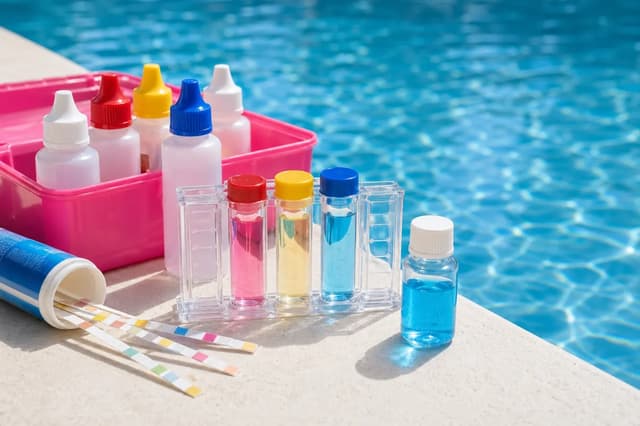
| Test strips | Quick FC and pH checks between cleanings | Imprecise color matching; poor at high chlorine; rough CYA and CH readings |
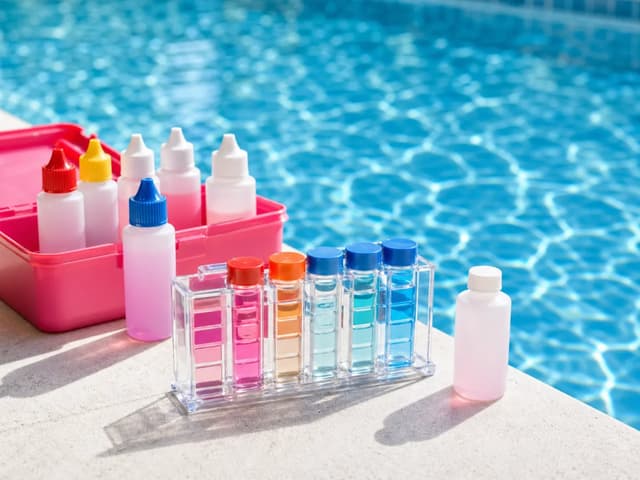
| DPD drop kit (color match) | Routine chlorine and pH testing | Color bleaches out at high chlorine; hard to read at shock levels |
| FAS-DPD drop kit (count drops) | Precise FC and CC, including at shock level; the choice of most pros | Takes a few minutes and some practice |
| Digital photometer or salt meter | Consistent readings without color judgment | Costs more; needs calibration and reagents |
Use strips for quick checks and a drop-count kit that reads FC, CC, pH, TA, CH and CYA for any number you plan to act on. Sample from elbow depth, away from the return jets, and test pH before adding acid or base.
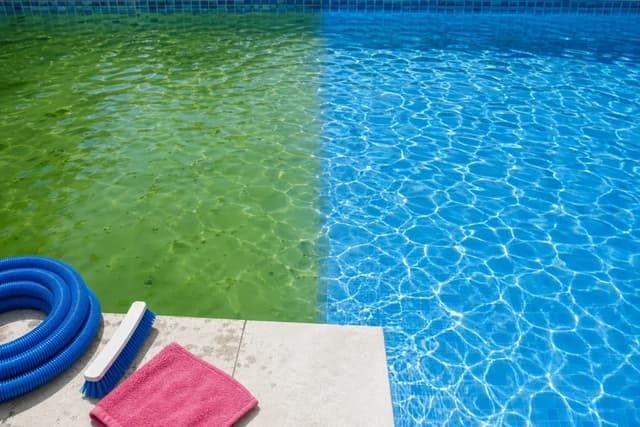
When several readings are off, adjust in this order: alkalinity, then pH, then calcium and stabilizer, then chlorine. If the water is already green, follow the green pool cleanup instead.
When to call a pro
Weekly chemistry is manageable with a good test kit. Call a pro when the numbers will not hold or the readings contradict what you see in the water.
- pH rises every few days no matter how much acid you add.
- CYA or calcium is high enough to need a partial drain, and you are unsure about draining safely.
- Scale forms on tile or plaster etches while readings look normal.
- The salt system shows errors or low output with salt in range.
What weekly pool service costs near you
Frequently asked questions
What is the most important pool chemical level?
Free chlorine, read against your stabilizer level. If free chlorine stays at or above 7.5 percent of the CYA reading, the water stays sanitized and algae-free. pH comes second because it affects comfort, surfaces and chlorine strength.
What should pool chemicals be for a salt water pool?
Most salt pools run free chlorine around 5 to 6 ppm, pH 7.4 to 7.6, alkalinity 60 to 80 ppm, CYA 60 to 80 ppm, and salt in the range the generator manual specifies, usually 3,000 to 3,400 ppm.
Why does my pool smell like chlorine?
A strong chlorine smell usually means combined chlorine, the chloramines that form when chlorine reacts with sweat and urine. Raise free chlorine to shock level until combined chlorine drops to 0.5 ppm or below.
Are pool test strips accurate enough?
They are fine for quick chlorine and pH checks. For decisions such as shocking, adding stabilizer or adjusting calcium, a drop-count test kit gives far more reliable numbers.
How do I lower cyanuric acid in my pool?
Replace water. Stabilizer does not break down in normal use, so a partial drain and refill is the standard fix. Draining a third of the water lowers CYA by about a third, assuming the fill water has none.
Should I adjust pH or alkalinity first?
Alkalinity first, because it controls how pH behaves. Once alkalinity is in range, fine-tune pH. Adjusting pH first often means doing it twice.
Poolside guides are written for homeowners and checked against current pool chemistry and equipment guidance. Doses assume a standard drop test kit and are given per 10,000 gallons.
More Poolside guides →