Start pool ownership by establishing what you have, what condition it is in and who is responsible for each part of its care. A clear pool and a running pump do not answer those questions. Your first week should produce an equipment record, a water-testing routine and an agreed plan for unresolved issues.
Before the first swim: establish the current condition
Confirm that the pool’s barriers, access controls and other protective features are intact and that the adults responsible for the pool understand supervision and emergency arrangements. If something appears damaged or its condition is unknown, arrange a qualified assessment. This article is a care handoff, not a safety inspection or certification.
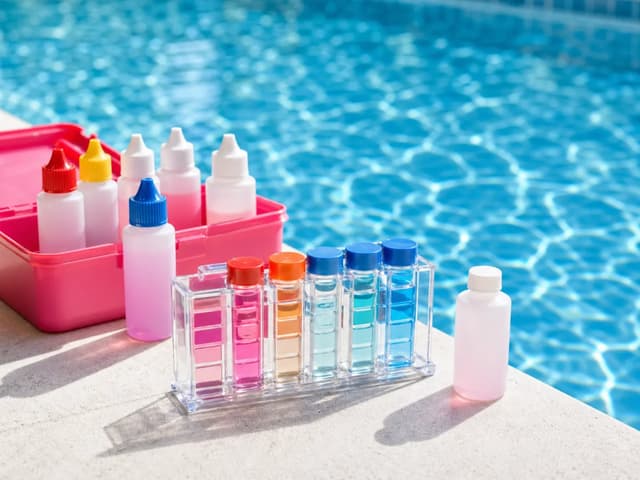
Test the water using a suitable kit and its instructions. CDC recommends checking disinfectant and pH at least twice daily, more often with heavy use. For chlorine pools, its home-pool guidance gives a pH range of 7.0–7.8 and a minimum chlorine concentration of 1 ppm, or 2 ppm when cyanuric acid is used. These are public-health minimums, not a complete prescription for your pool or a universal maximum.
Day one: collect the records that prevent guesswork
- Pool volume, with its source: drawings, measured fill or geometric estimate.
- Surface type, sanitizer system and approximate pool age if known.
- Pump, filter, heater, sanitizer and controller manufacturer/model; safely accessible label photos.
- Equipment manuals, installation records and warranty documents.
- Last maintenance report, recent water tests and any open repair recommendation.
- Current provider agreement, billing period, access arrangements and cancellation terms.
A missing manual or unknown volume is a task to resolve, not a reason to borrow numbers from a similar pool. Keep private access details separate from the record you send for an estimate. Use the equipment repair preparation guide when an existing fault needs diagnosis.
Days two and three: learn the normal operating state
| Ask the previous owner or provider | What to document |
|---|---|
| Which program is currently active? | Named schedule, displayed stages and the purpose of each stage. |
| What is the clean filter baseline? | Pressure, pump setting, mode and date of service. |
| How is sanitizer supplied? | Exact system, product instructions and who monitors it. |
| What changes during a vacation? | Who checks water and who can authorize a service call. |
| What needs attention now? | Observed issue, next action, responsible person and target date. |
Ask for a demonstration of normal user controls by someone who understands the installed system. Do not learn by experimenting with valves, electrical covers or heater internals. Photograph normal displays only where safely accessible. A short record of the established setup is more useful than memorizing a series of unlabeled button presses.
Assign work between professional visits
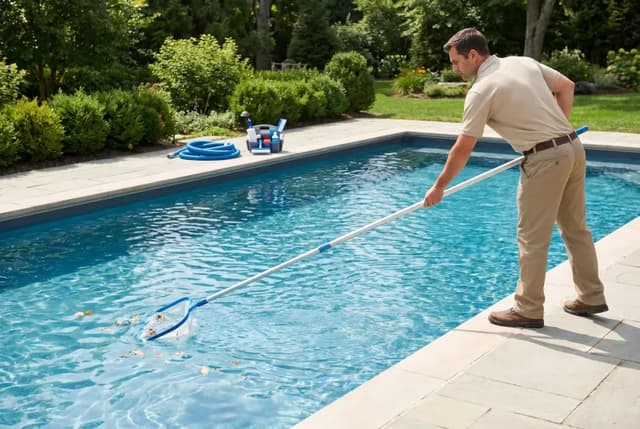
A service company’s visit schedule and your pool’s testing needs are different things. Decide who checks the water between visits, observes unusual conditions and follows product-specific retesting instructions. If the provider handles only testing and chemicals, brushing, debris removal and filter service may still need separate arrangements.
The pool service scope checklist helps turn a phrase such as full service into named tasks. Record what happens after heavy use, bad weather, a missed visit or a change in water appearance. A named person and a clear contact method are more useful than an assumption that someone else will notice.
By the end of the week: make the routine repeatable
- Start a maintenance log with real observations; leave unmeasured fields blank.
- Resolve which tests and maintenance tasks you can competently perform.
- Keep the product label and measuring instructions with each chemical decision.
- Review chemical storage for damaged containers, missing labels and incompatible products.
- Confirm the next professional visit and all separately billed work.
- List unresolved issues with an owner and a date for follow-up.
Build your budget from the actual service agreement, products you use, equipment energy and known periodic work. Use the quote calculator for billing comparisons and the pump electricity calculator for measured power and your tariff. Do not treat a generic online annual cost as the cost of your particular pool.
Frequently asked questions
What should a new pool owner buy first?
Identify the pool, sanitizer system and suitable testing method before buying chemicals or replacement equipment. Product compatibility and instructions come first.
Is weekly pool service enough?
A weekly visit does not cover every responsibility between visits. Assign water testing, observation and follow-up separately.
Can I use the previous owner’s chemical amounts?
Do not copy amounts without current tests, the exact product label and a reliable volume. Record previous practices as history, not instructions.
What if I cannot find the equipment manuals?
Use the manufacturer and exact model from accessible labels to locate the correct documentation, or ask a qualified provider to identify the equipment.
How this checklist was prepared
Poolside designed the handoff sequence and worksheets. CDC supports the stated home-pool testing guidance; model manuals and product labels govern individual equipment and treatments. Source review: October 23, 2026. This checklist does not claim to cover every local barrier, electrical or public-pool requirement.
Poolside creates practical worksheets and explanations for pool owners. These resources were prepared with AI assistance using the references listed in each article. Examples are illustrative; no field testing or independent technician review is claimed.
More Poolside guides →